
The CA Inter syllabus is your plan for the next few weeks. With the January 2027 exams starting on 2 January, you have under six weeks, so knowing exactly what is in scope, and which material applies to your attempt, saves real time.
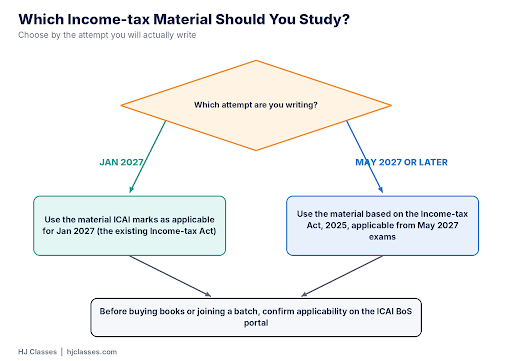
This guide lists all six papers, the chapters inside each, the exam pattern and passing rules, plus one change that matters for Taxation: January 2027 is the last attempt that follows the existing Income-tax Act.
CA Inter Syllabus 2027: Subjects and Marks
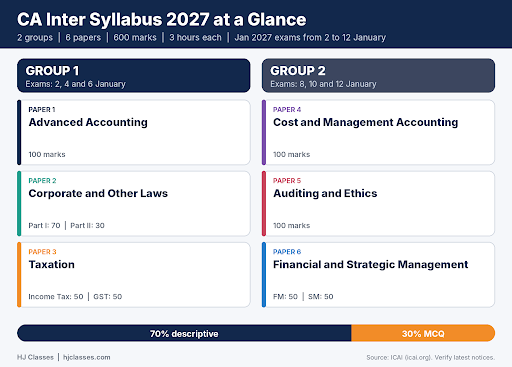
CA Intermediate has six papers of 100 marks, split into two groups of three. You can attempt one group or both in the same sitting.
| Group | Paper | Subject | Marks | Exam date |
|---|---|---|---|---|
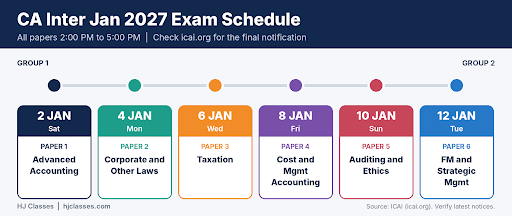
| Group 1 | 1 | Advanced Accounting | 100 | 2 Jan 2027 |
| Group 1 | 2 | Corporate and Other Laws | 100 | 4 Jan 2027 |
| Group 1 | 3 | Taxation | 100 | 6 Jan 2027 |
| Group 2 | 4 | Cost and Management Accounting | 100 | 8 Jan 2027 |
| Group 2 | 5 | Auditing and Ethics | 100 | 10 Jan 2027 |
| Group 2 | 6 | Financial Management and Strategic Management | 100 | 12 Jan 2027 |
CA Inter Exam Pattern 2027
| Feature | Details |
|---|---|
| Papers and marks | Six papers, 100 marks each, 600 in total |
| Time and slot | 3 hours per paper, 2 PM to 5 PM |
| Question mix | About 70 marks descriptive and 30 marks case-scenario MCQs in every paper |
| Negative marking | None in the MCQ portion |
| Split papers | Paper 2: Part I 70, Part II 30. Paper 3: Income Tax 50, GST 50. Paper 6: FM 50, SM 50 |
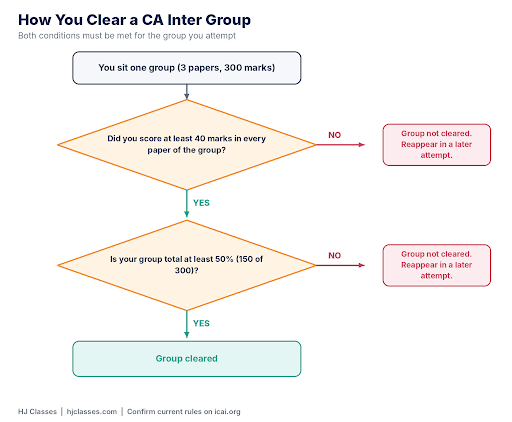
| Passing rule | At least 40% in every paper and 50% in the group aggregate |
The MCQ share rewards students who know the chapters well, because a case study can touch several provisions at once. The pass rule also means a weak paper can fail you even when the rest go well. Use the check below, and read ICAI's current rules for sitting both groups together.
Group 1 Syllabus
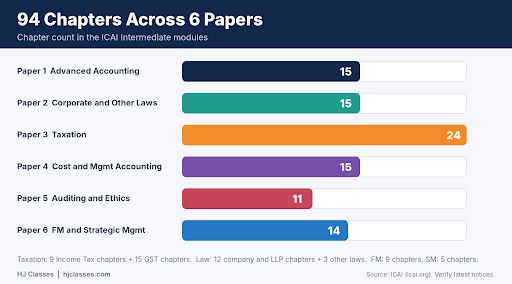
Paper 1: Advanced Accounting (15 chapters)
Accounting Standards come first and make up most of the paper's base. Company accounts then apply them.
| Module | Chapters |
|---|---|
| Module 1 (Ch 1-4) | Introduction to Accounting Standards; Framework for preparation and presentation of financial statements; Applicability of Accounting Standards; Presentation and disclosure based standards |
| Module 2 (Ch 5-10) | Assets based standards; Liabilities based standards; Standards on items impacting financial statements; Revenue based standards; Other standards; Standards for consolidated financial statements |
| Module 3 (Ch 11-15) | Financial statements of companies; Buyback of securities; Amalgamation of companies; Reconstruction of companies; Branch accounting including foreign branches |
Paper 2: Corporate and Other Laws (15 chapters)
| Part and module | Chapters |
|---|---|
| Part I, Module 1 (70 marks) | Preliminary; Incorporation of a company; Prospectus and allotment of securities; Share capital and debentures; Acceptance of deposits; Registration of charges |
| Part I, Module 2 | Management and administration; Declaration and payment of dividend; Accounts of companies; Audit and auditors; Companies incorporated outside India |
| Part I, Module 3 | The Limited Liability Partnership Act, 2008 |
| Part II: Other Laws (30 marks) | The General Clauses Act, 1897; Interpretation of Statutes; The Foreign Exchange Management Act, 1999 |
Paper 3: Taxation (24 chapters)
| Section | Chapters |
|---|---|
| A. Income Tax Law (50 marks) | Basic concepts; Residence and scope of total income; Heads of income; Income of other persons included in total income; Aggregation, set-off and carry forward of losses; Deductions from gross total income; Advance tax, TDS and TCS; Return filing and self assessment; Computation and optimisation of tax liability |
| B. GST (50 marks) | Introduction; Supply; Charge of GST; Place of supply; Exemptions; Time of supply; Value of supply; Input tax credit; Registration; Tax invoice, credit and debit notes; Accounts and records; E-way bill; Payment of tax; TDS and TCS; Returns |
Which Income-tax Material Applies to Jan 2027?
Group 2 Syllabus
Paper 4: Cost and Management Accounting (15 chapters)
| Module | Chapters |
|---|---|
| Module 1 (Ch 1-7) | Introduction; Material cost; Employee cost and direct expenses; Overheads and absorption costing; Activity based costing; Cost sheet; Cost accounting systems |
| Module 2 (Ch 8-15) | Unit and batch costing; Job costing; Process and operation costing; Joint products and by-products; Service costing; Standard costing; Marginal costing; Budgets and budgetary control |
Paper 5: Auditing and Ethics (11 chapters)
| Module | Chapters |
|---|---|
| Module 1 (Ch 1-5) | Nature, objective and scope of audit; Audit strategy, planning and programme; Risk assessment and internal control; Audit evidence; Audit of items of financial statements |
| Module 2 (Ch 6-11) | Audit documentation; Completion and review; Audit report; Special features of audit of different entities; Audit of banks; Ethics and terms of audit engagements |
Paper 6: Financial and Strategic Management (14 chapters)
| Section | Chapters |
|---|---|
| A. Financial Management (50 marks) | Scope and objectives; Types of financing; Ratio analysis; Cost of capital; Capital structure; Leverages; Investment decisions; Dividend decision; Working capital management |
| B. Strategic Management (50 marks) | Introduction; External environment analysis; Internal environment analysis; Strategic choices; Strategy implementation and evaluation |
How to Get the ICAI Syllabus and Study Material
ICAI publishes the syllabus and modules on its Board of Studies portal. Follow these steps.
- 1. Open icai.org and go to the student section.
- 2. Select the BoS Knowledge Portal and choose the Intermediate course.
- 3. Open the paper, then read the applicability label on the module page, such as the exam or attempt it is meant for.
- 4. Download the chapters and the practice manual for that paper.
The applicability label matters most for Taxation, where material for different attempts sits side by side.
How to Prioritise Across Six Papers
Each paper rewards a different kind of effort. Use the table to match your hours to the work.
| Paper | What it rewards | HJ Classes batch |
|---|---|---|
| Advanced Accounting | Solving illustrations without peeking | Group 1 combo |
| Corporate and Other Laws | Provisions, exceptions and time limits | Law batch |
| Taxation | Updated provisions plus computation practice | Group 1 combo |
| Cost and Management Accounting | Formula recall and chapter-wise numericals | Costing batch |
| Auditing and Ethics | Understanding the reason for each procedure | Audit batch |
| FM and Strategic Management | Numericals for FM, repeated revision for SM | FM batch |
Looking for CA Inter online classes? Browse all CA Intermediate courses or the exam-oriented batches built for the final weeks. They are available as live-streamed and recorded lectures, so you can learn from anywhere.
Based in Pune? If you want CA Intermediate classes in Pune, visit our centre at Prestige Point, Shukrawar Peth, or call 9975242929 to ask about current batches.
Common Mistakes to Avoid
- Studying Income-tax material meant for May 2027 or later.
- Treating the 30% MCQ part as an afterthought, since case scenarios need full chapter knowledge.
- Leaving one paper weak, which can fail the whole group despite good scores elsewhere.
- Reading Advanced Accounting and Costing without solving questions.
- Skipping timed tests until last week.
Final Thoughts
The CA Inter syllabus 2027 is six papers and 94 chapters, but it is manageable once you treat each paper on its own terms. Confirm the material for your attempt, mind the Income-tax change, and keep testing yourself as the exam nears.
Frequently Asked Questions
How many papers are there in the CA Inter syllabus 2027?
There are six papers of 100 marks each. Group 1 has Advanced Accounting, Corporate and Other Laws, and Taxation. Group 2 has Cost and Management Accounting, Auditing and Ethics, and Financial and Strategic Management.
Is there negative marking in CA Inter?
No. Every paper has about 30% case-scenario MCQs, and there is no negative marking in that portion.
Which Income-tax Act applies to the January 2027 exam?
January 2027 is the last attempt under the existing Income-tax Act. The Income-tax Act, 2025 applies from the May 2027 exams onwards.
What are the passing marks for CA Inter?
You need at least 40% in every paper and 50% in the aggregate of the group you attempt.
Can I appear for only one group in CA Inter?
Yes. You can attempt Group 1 only, Group 2 only, or both groups in the same attempt.